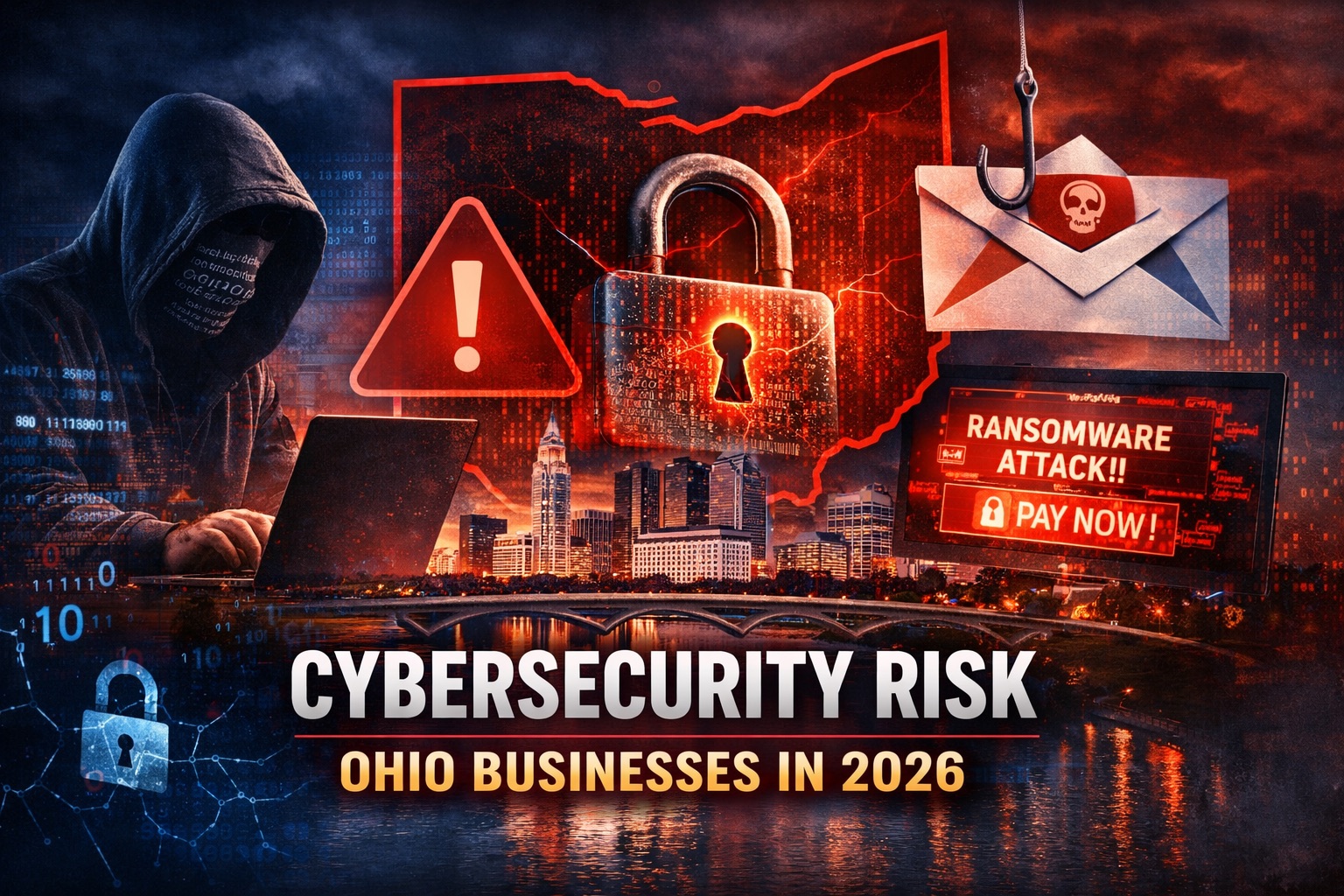
Cybersecurity risk Ohio businesses face in 2026 is no longer theoretical. It is a daily operational threat impacting companies across manufacturing, healthcare, finance, and professional services.
A mid-sized Ohio manufacturer recently experienced a ransomware attack that shut down operations for four days. The total impact exceeded $180,000 in lost productivity, recovery costs, and client delays.
This is not an isolated incident.
Cybersecurity risk Ohio businesses face is increasing rapidly as attackers target organizations with weaker defenses, outdated systems, and reactive IT environments.
A mid-sized Ohio manufacturer clicked what looked like a routine vendor invoice.
Within hours, ransomware locked their production systems.
Operations stopped for four days.
The financial impact exceeded $180,000… before factoring in reputational damage.
This isn’t rare anymore.
It’s happening across Ohio every week.
And yet many business owners still believe:
“It won’t happen to us.”
That assumption is where the real risk begins.
Cybersecurity Risk Ohio Businesses Face Is No Longer a Big Company Problem
Small and mid-sized businesses are now the primary target.
Not because they’re more valuable…
…but because they’re easier to breach.
Most organizations still:
• rely on outdated tools
• lack continuous monitoring
• assume basic protection is enough
• operate without structured security systems
Attackers know this.
And they’re exploiting it at scale.
The Types of Cybersecurity Threats Ohio Businesses Are Facing in 2026
Today’s threats are faster, more automated, and more precise:
• ransomware locking entire systems
• AI-driven phishing that mimics real people
• credential theft from weak authentication
• unpatched systems acting as entry points
• cloud misconfigurations exposing data
These are not edge cases.
They are the default threat environment.
Why This Problem Is Accelerating in 2026
Cybersecurity risk is increasing for one simple reason:
Technology is more central to operations than ever before.
In 2026, Ohio businesses face:
• AI-driven attacks at scale
• increased cloud and remote dependency
• stricter insurance requirements
• higher expectations for uptime and security
The margin for error is shrinking.
What used to be an inconvenience is now a full operational disruption.
Most Businesses Don’t See the Risk Until It’s Too Late
Cyber risk doesn’t announce itself.
There are no obvious warning signs.
Systems appear to run normally.
Until they don’t.
Without proactive visibility:
• threats go undetected
• vulnerabilities remain open
• risk compounds quietly
This is why more companies are moving toward structured cybersecurity services in Ohio.
Not after something happens…
…but before it does.
Cybersecurity and Downtime Are Directly Connected
A cyber incident doesn’t just affect IT.
It stops the business.
• systems become inaccessible
• operations slow or halt
• customer response is delayed
• teams shift into reactive mode
This is the same pattern seen in reactive environments.
If this sounds familiar, it overlaps directly with the issues outlined in
Why Reactive IT Support Costs Ohio Businesses More Than They Think.
The Cost of Cybersecurity Risk Goes Far Beyond Dollars
Financial loss is only one part of the equation.
The real impact includes:
• loss of trust
• operational instability
• internal disruption
• compliance pressure
• long-term brand damage
Most businesses underestimate this until they experience it.
Why Reactive IT Environments Multiply Cyber Risk
Reactive IT support creates exposure.
When systems are only addressed after problems occur:
• patches are delayed
• vulnerabilities remain open
• threats go unnoticed
• response is slower
This creates the exact conditions attackers look for.
What a Proactive Cybersecurity Approach Actually Looks Like in 2026
Effective cybersecurity is not one tool.
It’s a system.
A structured approach includes:
• 24/7 monitoring and threat detection
• automated patching and vulnerability management
• phishing-resistant authentication
• endpoint protection across all devices
• ongoing employee awareness training
• verified, tested backup systems
This is no longer advanced.
It is baseline.
How to Evaluate Your Current Cybersecurity Risk
Ask these questions honestly:
• Do we have real-time visibility across systems and cloud apps?
• Are updates and patches automated and verified?
• Could we detect and contain a breach quickly?
• Are employees trained on modern phishing threats?
• Are backups tested and recoverable under pressure?
If any answer is unclear…
your risk is higher than you think.
Frequently Asked Questions
Are Ohio small businesses really targets?
Yes. Smaller organizations are targeted more frequently because they typically have weaker defenses.
What is the most common cybersecurity threat right now?
Ransomware, often initiated through phishing, remains the most common and most damaging.
How can businesses reduce cybersecurity risk?
By implementing proactive systems: monitoring, patching, authentication, training, and verified backups.
The Bottom Line
Cybersecurity risk is not a future issue.
It is a current business risk.
Not a question of if…
but when.
The companies that operate with visibility and structure avoid disruption.
The ones that rely on assumptions don’t.
Next Step
If you want a clear view of your current risk, CTMS can help.
A structured assessment identifies:
• where exposure exists
• what gaps need to be addressed
• how to reduce risk moving forward