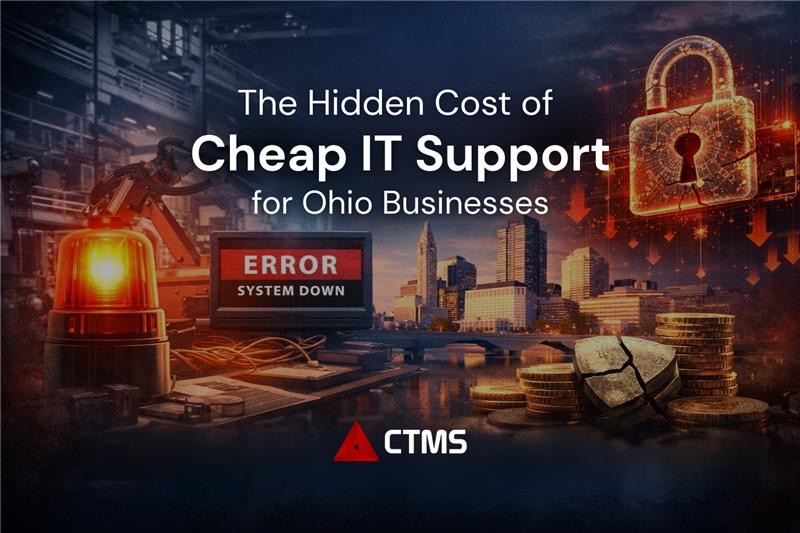
Many business owners don’t realize how much cheap IT support costs Ohio businesses over time. As issues compound, many companies eventually transition to structured solutions like managed IT services in Ohio.
A mid-sized manufacturing company in Ohio recently switched to a lower-cost IT provider to save roughly $800 per month.
Within six months, a single system outage brought production to a halt for nearly half a day.
The estimated loss from that one incident exceeded $40,000.
What looked like a cost-saving decision quietly became a much larger operational risk.
Many companies searching for cheap IT support costs Ohio businesses less upfront don’t realize what they’re actually giving up.
On paper, it looks like a smart move… lower monthly cost, fewer commitments, and the assumption that all IT providers deliver roughly the same outcome.
In reality, most businesses discover the opposite.
Cheap IT support doesn’t reduce cost… it redistributes it into areas that are harder to measure, harder to control, and far more expensive over time.
Businesses looking for low-cost solutions often start with IT support, but quickly realize that cheap service creates recurring issues instead of solving them.
Why Cheap IT Support Costs Ohio Businesses More
Low-cost IT providers typically operate with limited structure and fewer proactive systems in place.
Instead of preventing issues, they respond after something breaks.
That creates a pattern:
• problems occur unexpectedly
• response times vary
• work slows or stops
• fixes are applied temporarily
Over time, this leads to recurring issues and operational drag.
Businesses that rely on consistent performance often begin exploring more structured solutions like managed IT services in Ohio once the impact becomes clear.
Cheap IT Support Doesn’t Eliminate Cost… It Shifts It
What appears as savings on a monthly invoice often shows up elsewhere:
• employee downtime
• delayed internal processes
• missed opportunities
• recurring technical issues
• increased reliance on reactive support
These costs rarely appear in a report, but they compound quickly.
And because they are spread across teams and time, they often go unnoticed until they become significant.
The Real Cost of Reactive IT Support
Reactive IT environments create a cycle that is difficult to escape.
An issue occurs…
Work is interrupted…
Support is contacted…
Resolution takes time…
Operations resume… until the next issue.
Even small disruptions add up.
Two hours of downtime across a team is not just two hours… it’s multiplied across every employee affected.
Over weeks and months, this creates measurable business impact.
This is why more companies are shifting toward structured support models like IT help desk and support services, where response time and system visibility are built into the process.
Cybersecurity Risk Is Higher Than Most Realize
One of the most overlooked risks of cheap IT support is cybersecurity exposure.
Lower-cost providers often lack structured systems for:
• proactive monitoring
• patch management
• endpoint protection
• employee security awareness
• backup verification
For Ohio businesses, this creates real vulnerability.
Cyber threats are no longer rare… they are constant.
Without a proactive strategy, a single incident can outweigh years of perceived cost savings.
This is why more organizations are investing in cybersecurity services in Ohio to protect operations, data, and long-term business continuity.
What “Affordable” IT Support Actually Costs
Consider a simple scenario.
A business saves $1,000 per month by choosing a lower-cost provider.
Over a year:
$12,000 saved
Now factor in:
• 2 hours of downtime per month
• 10 employees impacted
• average cost of $35 per hour
2 × 10 × 35 = $700/month in lost productivity
$700 × 12 = $8,400 annually
And that does not include:
• lost revenue opportunities
• delayed deliverables
• customer experience impact
And in many cases, downtime is only part of the equation.
Industry patterns show that small to mid-sized businesses can experience five-figure losses from a single disruption, especially in sectors like manufacturing, legal, and professional services across Ohio.
If this sounds familiar, CTMS offers a structured IT cost and risk review designed to identify where businesses are losing time, money, and operational efficiency.
Request a no-obligation IT assessment
Why This Problem Is Getting Worse in 2026
The gap between cheap IT support and structured IT management is widening.
In 2026, businesses are facing:
• more sophisticated cybersecurity threats
• increased reliance on cloud and remote systems
• higher expectations for uptime and speed
• growing compliance pressures in regulated industries
As technology becomes more central to operations, the margin for error continues to shrink.
What may have worked five years ago is no longer sufficient today.
What most companies actually need is responsive IT support that resolves problems the first time instead of letting them repeat.
The Difference Between Cheap IT Support and Strategic IT Support
The difference is not just price… it’s philosophy.
Cheap IT support focuses on:
• fixing issues after they happen
• minimizing immediate cost
• short-term problem solving
Strategic IT support focuses on:
• preventing issues before they occur
• improving system performance
• aligning IT with business operations
• reducing long-term risk
This shift is what separates businesses that constantly deal with disruptions from those that operate consistently and predictably.
Why More Ohio Businesses Are Re-Evaluating IT Providers
More organizations are recognizing that IT is not just a support function… it’s a core part of daily operations.
As a result, they are prioritizing:
• proactive monitoring
• structured support systems
• cybersecurity-first strategies
• faster, more reliable response
This shift is not about spending more.
It’s about eliminating hidden costs and creating operational stability.
Businesses looking to improve long-term performance often evaluate broader IT solutions and technology strategy to align their systems with growth.
How to Evaluate Your Current IT Support
If you’re unsure whether your current setup is costing more than it should, ask:
• How often do we experience downtime?
• Are issues being resolved permanently… or repeating?
• How fast is response time when something breaks?
• Do we have a clear cybersecurity strategy?
• Are we operating proactively… or reacting constantly?
The answers usually provide clarity quickly.
Frequently Asked Questions
Is cheap IT support ever worth it?
In very small environments with minimal reliance on technology, it can work short-term. However, as businesses grow, the risks and hidden costs typically outweigh the savings.
How much should IT support cost in Ohio?
Costs vary based on size and complexity, but most structured managed IT services are designed to reduce total operational cost—not just monthly spend.
What is the biggest risk of cheap IT support?
The biggest risk is not a single issue… it’s the accumulation of downtime, security exposure, and unresolved problems over time.
The Bottom Line
Cheap IT support is rarely cheap.
It simply moves the cost into:
• lost time
• increased risk
• operational inefficiency
For businesses that depend on technology every day, the better question is:
What is unreliable IT costing us right now?
As these issues compound, many organizations shift toward managed IT services to eliminate recurring problems instead of constantly reacting to them.
Next Step
If you want a clear picture of where your current environment stands, CTMS can help.
A structured review will identify:
• hidden inefficiencies
• areas of risk
• opportunities for improvement