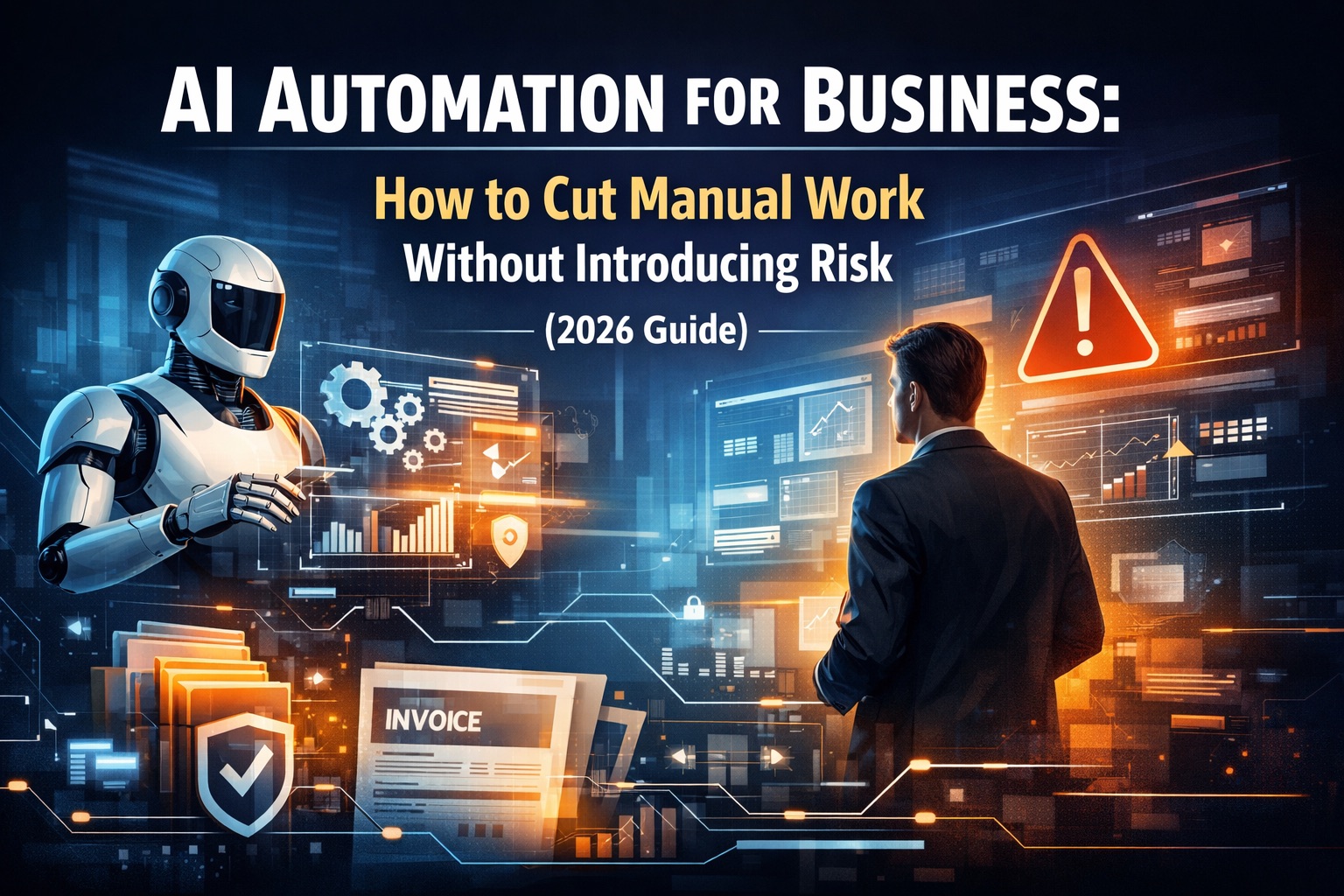
Introduction to AI automation for business
If you’re looking into AI automation, you’re not chasing a trend.
You’re trying to fix something:
- Too much manual work
- Slow internal processes
- Inconsistent reporting
- Teams doing work that shouldn’t require people
AI can solve that.
But in most businesses right now…
It’s creating a new problem.
Uncontrolled AI usage is introducing risk faster than it’s creating value.
If you’re exploring how to apply this safely, start with how AI fits into a structured environment like AI automation solutions, not as a standalone tool.
What AI Automation Actually Means (In Practice)
AI is not a tool.
It’s an operational layer.
When it’s implemented correctly:
- Manual workflows run automatically
- Processes stop varying by employee
- Data is structured before decisions are made
- Everything runs inside defined boundaries
For a mid-sized business, this shows up as:
- invoices processed without manual entry
- reports generated nightly instead of manually compiled
- internal questions answered without interrupting people
- repetitive approvals handled without email chains
If AI isn’t doing this…
It’s either underused or creating risk.
As businesses adopt automation, they quickly realize it requires a strong foundation of managed IT services to work reliably.
What’s Actually Happening Inside Businesses Right Now
AI is already inside your business.
The issue is no one is controlling it.
We consistently see:
- Employees pasting company data into AI tools
- No defined usage policies
- No visibility into where data is going
- Outputs being trusted without validation
The result:
- Data exposure
- Compliance gaps
- Inconsistent outputs across teams
- Decisions built on unverified information
This is the same pattern we see when companies adopt tools before aligning with broader managed IT services in Ohio strategies.
That’s not adoption.
That’s risk accumulating quietly.
Where AI Actually Creates Value (Real Use Cases)
AI works when it’s tied to specific workflows, not broad ideas.
Here’s where it consistently delivers:
Accounts Payable & Finance Ops
- Invoice data extracted automatically
- Reconciliation runs nightly instead of manually
- Audit logs created without extra work
Reporting & Forecasting
- Data pulled from multiple systems and standardized
- Reports generated on schedule without human assembly
- Leadership sees consistent numbers across teams
Internal Knowledge & SOP Access
- Employees get answers instantly instead of asking around
- Documentation becomes usable instead of buried
Customer Support & Internal Requests
- Repetitive requests handled automatically
- Responses become consistent across the organization
If you’re comparing providers or approaches, this is where differences show up most clearly between vendors — especially in structured environments like those outlined in best managed IT companies in Ohio.
Where this fails:
- when data isn’t structured
- when systems aren’t connected
- when no one owns validation
Where AI Breaks (And Why It’s Dangerous)
AI doesn’t fail loudly.
It fails quietly.
- Outputs that sound correct… but aren’t
- Sensitive data moving without control
- Decisions made on incomplete inputs
And because everything feels faster…
No one questions it.
That’s how small issues turn into real operational or compliance problems.
Automation only performs as expected when it’s supported by consistent IT infrastructure management.
How to Evaluate AI in Your Business (Fast Audit)
Before expanding AI anywhere, answer this:
- Where does our data go when AI is used?
- Who has access to it?
- Are there defined boundaries or none at all?
- How are outputs verified before decisions are made?
- Can leadership see how AI is being used across teams?
If you don’t have clear answers…
You don’t have an AI strategy.
What Actually Works (Implementation Reality)
AI should never sit outside your environment.
It should be built into:
- your systems (ERP, CRM, internal tools)
- your security model (access, permissions)
- your workflows (not layered on top of them)
What this looks like in practice:
- AI runs inside controlled environments
- access is role-based, not open-ended
- high-risk outputs require human validation
- sensitive data never leaves defined boundaries
This is where strong infrastructure matters. If the foundation isn’t there, AI won’t fix it — it will expose it. That’s why most successful implementations are tied back to a broader managed IT services foundation.
Where Most Businesses Go Wrong
They start with tools.
They should start with:
- where work is breaking
- what data is involved
- where risk exists
Then choose tools that fit that structure.
Anything else leads to scattered adoption and hidden exposure.
The Real Opportunity
AI is not a time-saving tool.
It’s leverage.
Done right, it allows you to:
- increase output without adding headcount
- reduce operational friction
- standardize execution across the business
That compounds fast.
Many of the risks tied to automation are outlined here: cybersecurity risk Ohio businesses.
The Real Decision
AI is already being used inside your business.
The only decision left is:
Will it be controlled…
or invisible?
One is a strategy.
The other is a liability.
Long-term success with AI depends on structured business technology management that keeps systems aligned and secure.
Want to See Where AI Actually Fits in Your Business?
If you’re already using AI… or thinking about it…
We’ll show you:
- where it creates real value
- where risk exists right now
- and how to implement it correctly
Start here:
AI automation services
Or explore how this fits into your broader environment:
Managed IT services Ohio